Scientific Program > Keynotes
Keynotes
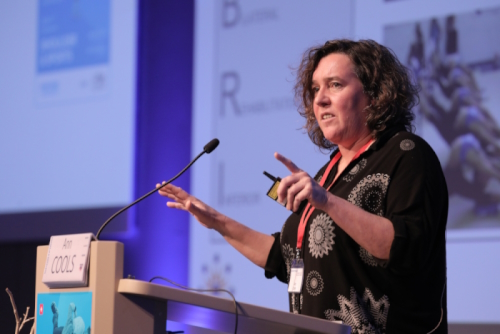 |
Pr Ann COOLS
From the lab to the practice: How can we implement biomechanical studies in shoulder rehabilitation programs?
|
|
Ann Cools is a physiotherapist, working as a professor at the Department of Rehabilitation Sciences at the Ghent University, Belgium. Her topic of research and teaching expertise, as well as her clinical work is shoulder rehabilitation in general, and sport specific approach and guidelines for exercise prescription in particular. She finished her PhD in 2003, debating scapular involvement in sports related shoulder pain in the overhead athlete, and she has published more than 200 papers in peer-reviewed international journals, wrote contributions and chapters in several international recognized books, and gives several courses on a national and international level. She was head of the Physical Therapy Education at the Ghent University 2008-2016, founding member and president of the European Society of Shoulder and Elbow Rehabilitation (EUSSER) 2008-2012, and founding member and board member of the Flemish Shoulder Network 2016-2022.
Abstract: In the pursuit of defining optimal exercise programs for patients, multiple variables must be considered. These include patient-specific factors (such as age, baseline physical activity level, and comorbidities), as well as variables related to the specific objectives of the exercise program (e.g., muscle strengthening, restoration of muscle balance, or improvement of mobility). One source of evidence that can inform exercise selection and prescription is biomechanical research, including electromyographic (EMG) analyses of target muscle activation and three-dimensional movement analysis of the upper limb during rehabilitation exercises. The purpose of this presentation is to summarize current findings from biomechanical studies and to discuss their application in clinical practice. While grounded in scientific evidence, the presentation aims to provide clinically relevant insights for healthcare professionals.
|
 |
Pr Evie VERRECKE
Shouldering Evolution: Insights into the Human Shoulder from Comparative Functional Morphology
|
|
Obtaining a fundamental understanding of the form-function relation of joint systems in the human body lies at the core of my research activities. I work together with clinicians to investigate musculoskeletal pathologies with a detailed appreciation of anatomical variation, and in collaboration with engineers we develop models based on accurate anatomical data that can be applied to study joint biomechanics. In my academic career, first as lecturer at the University of Liverpool, later as assistant and associate professor at KU Leuven, I have always combined my anatomical and biomechanical expertise, and I am convinced that these are also strong assets for this specific research project which aligns with my previous work. In the past 12 years, I have focused on the anatomy and biomechanics of the hand, thumb, and more recently shoulder, in healthy volunteers and patients, which has given me an international recognition in this field.
Abstract: The human shoulder is often celebrated for its remarkable mobility, yet this same design leaves it unusually vulnerable. A joint configuration that enables powerful overhead motion and high-velocity throwing may have conferred evolutionary advantages, but it also coincides with a striking burden of pathology—rotator cuff tears alone affect roughly one in five adults and increase steeply with age. If we want to understand why the human shoulder fails so frequently, it is worth asking whether our closest relatives, the hominoid primates, face similar mechanical challenges and, if not, what that discrepancy reveals. Hominoids share a broadly comparable shoulder architecture and routinely operate their forelimbs through large ranges of motion. They also load their shoulder girdle far more intensively than modern humans, given their reliance on the forelimbs for locomotion. Yet clinically significant shoulder disorders are rarely reported in these species. This contrast raises fundamental questions about form–function relationships, structural resilience, and the evolutionary pathways that have shaped the human shoulder. In this lecture, I will explore how comparative analysis of shape and biomechanics in extant hominoids—orangutans, gorillas, and chimpanzees—can sharpen our understanding of human vulnerability to shoulder injury. By integrating morphometric approaches with in vitro biomechanical testing and musculoskeletal modelling, we aim to disentangle which anatomical features support robustness and which may predispose to rotator cuff failure, impingement, or other degenerative conditions. The overarching goal is to show how an evolutionary and mechanically grounded perspective can inform both clinical reasoning and engineering strategies, challenging us to reassess long-held assumptions about why the human shoulder breaks down and what can be done to mitigate it.
|
|
 Chargement...